
Assessing Surgical Capacity in Guam: Current Strengths and Future Goals
Public health relevance—How does this work relate to a public health issue?
Guam serves as a regional area for surgical care in Micronesia; however, research regarding its surgical system is underrepresented.
Information obtained from this study can be used to accurately assess Guam’s current surgical capacity, a necessary factor in the acute and chronic care of oncologic and non-communicable diseases, which has not been done before.
Public health significance—Why is this work of significance to public health?
Identifies strengths and barriers in Guam’s surgical systems at two civilian hospitals and their ability to respond to the growing NCD/oncology burden and rising population from regional migration from across Micronesia.
Without an understanding of the current surgical system and the factors necessary to improve it, the region is left vulnerable to natural disasters and mass casualty incidents, all of which may further strain the current surgical capacity in Guam.
Public health implications—What are the key implications or messages for practitioners, policy makers, and/or researchers in public health?
There is an urgent need to invest in the infrastructure, workforce training, and specialty support to relieve the strain on Guam’s surgical systems to better expand equitable subspecialty surgical care for the native populations of the Pacific.
Given its relative resources and development, there is an opportunity for Guam to respond as a surgical hub for the region of Micronesia, especially the oncologic burden and the rising threat of geopolitical conflict and natural disasters.
Introduction
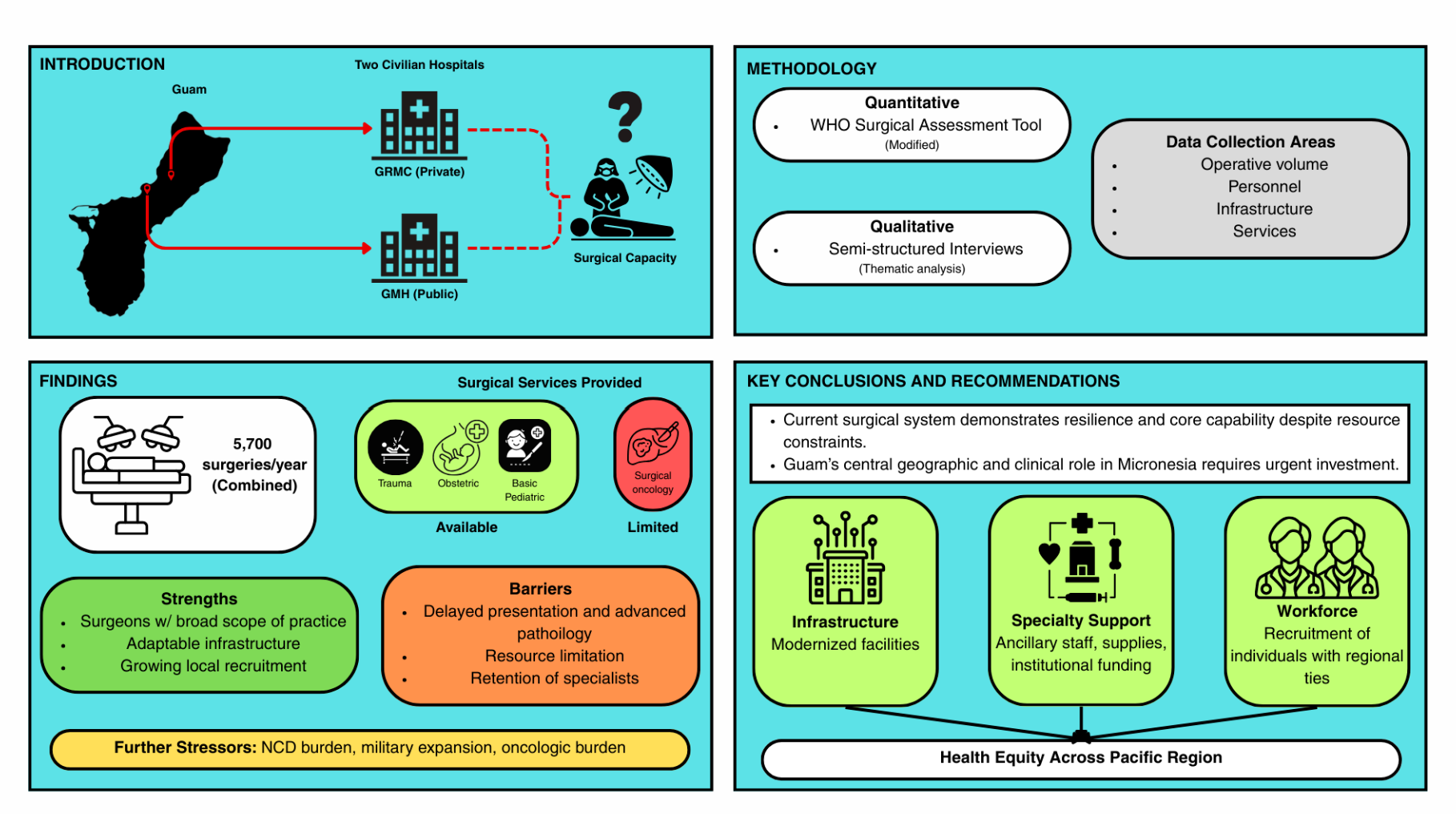
Guam, the largest U.S. territory in Micronesia, plays a central role in surgical care for the local indigenous community and surrounding Pacific Island nations, yet remains underrepresented in surgical systems research.
Methods
We conducted a mixed-methods study. Quantitative data were collected on operating volume, personnel, infrastructure, and surgical services at Guam Memorial Hospital (GMH) and Guam Regional Medical City (GRMC). Semi-structured interviews with hospital leadership and surgical providers captured qualitative insights on strengths, challenges, and future plans.
Results
GMH and GRMC collectively provide general emergency, obstetric, and basic pediatric surgery, although advanced subspecialty and oncologic care remain limited. Although surgeons are highly adaptable with broad-practice capability, challenges, including resource limitations, aging facilities, advanced presentation, and subspecialty recruitment, limit the cases that are operable on Guam, resulting in expensive medical transfer. Anticipated stressors such as oncologic and non-communicable disease burden may further strain the system, emphasizing the necessity for modernized facilities and targeted recruitment of surgeons with regional ties.
Conclusion
Strengthening Guam’s surgical capacity is essential for the provision of oncologic care and the advancement of health equity across the Pacific region, emphasizing an urgent need for investment in infrastructure, locally relevant workforce training, and regional policy development.